
The Spirituality of the Church
Does the spirituality of the church permit the silence of Christians?
I spent my adolescent years in 1960’s Mississippi. Members of theologically conservative churches often invoked “the spirituality of the church” to stay silent in the face of abhorrent societal sins like Jim Crow era racism.
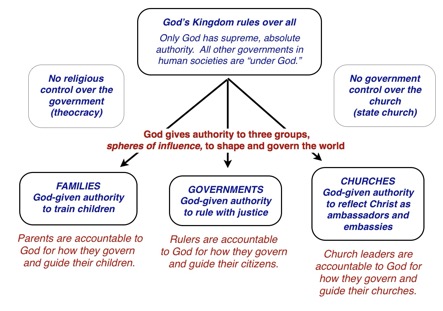
I myself believe in the doctrine of the church’s “spirituality.” But I do not believe in silent Christians. Jesus calls churches to be local embassies of God's kingdom, citizens of heaven (Philippians 3:20), entrusted by God with ministries of the Word, the Sacraments, and Prayer. So churches are not political entities with partisan agendas. There are followers of Jesus across the whole political spectrum. When churches do not wrap themselves in politics and ministers do not endorse politicians, it is not to preserve their tax-exempt status, but to stay faithful to their distinctive calling from God.
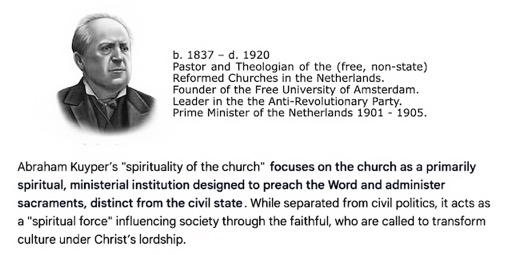
BUT … while churches are distinct from partisan parties, Jesus calls individual followers to influence and permeate society as preservative “salt” and truthful “light” (Matthew 5:13-14). If Jesus’ followers stay silent in the face of moral corruption and social decay, they become complicit. Christians, as John Stott observed, must remain “spiritually distinct, but not socially segregated.” Maintaining the church’s “spirituality” with Christian citizens’ “cultural engagement” was exemplified by the early 20th century Dutch Minister / Theologian / Prime Minister Abraham Kuyper.
Some examples of Christians who engaged in the political arena:
William Wilberforce (1759-1833) led the fight in the British Parliament to overturn the Slave Trade. He was influenced by two evangelical Anglicans, George Whitefield and John Newton, who urged him to stay engaged in the political fight to eliminate slavery.
American Patriot Patrick Henry (1736-99) was raised an Anglican, but was influenced by the Great Awakening and the Presbyterian evangelist Samuel Davies, one of the first non-Anglican preachers in Virginia. Henry credited Davies with inspiring his own oratory (“Give me liberty or give me death.”)
Dietrich Bonhoeffer (1906-45) warned the German state church about the political idolatry of the Nazi dictatorship. He argued that Christians should not retreat from the world but act within it. Bonhoeffer was martyred during the Nazi collapse.
Kuyper’s influence is evident in Ben Sasse, in recent interviews, as Sasse nears death from pancreatic cancer.